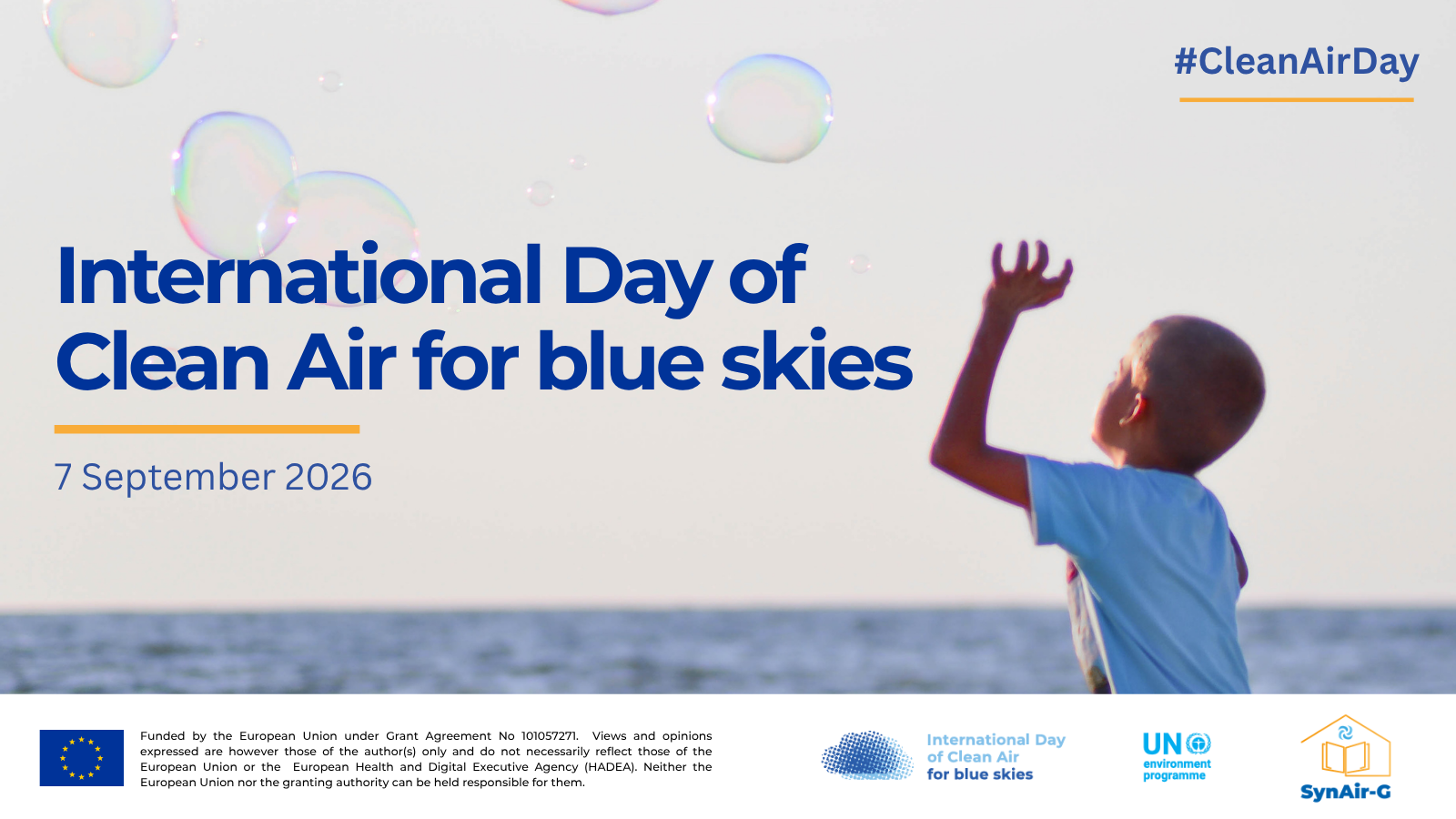
On 7 September, Syn-Air-G joins the International Day of Clean Air for Blue Skies, led by the United Nations Environment Programme. This year, the campaign highlights the economic case for action on air pollution and climate change. Acting on air pollution and climate change together can help create healthier communities, strengthen economies and reduce the costs of pollution-related illness and premature deaths.
For children and people living with asthma and allergies, the stakes are particularly high. And air pollution does not stop at the front door.
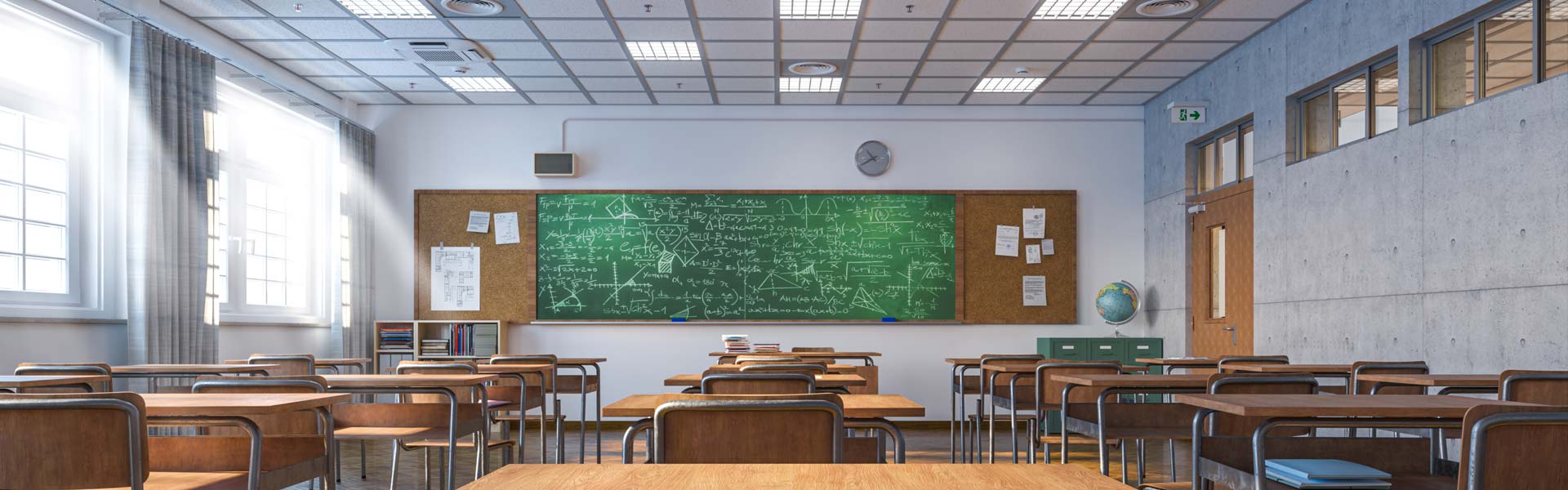
Indoor and outdoor air are closely interconnected. Pollutants move between the two, affecting our health wherever we are. For children, who spend much of their day in classrooms, this connection matters enormously, particularly during critical years of growth and development. This interaction can also have serious implications for those living with asthma and allergies.
SynAir-G therefore supports this year’s call for cleaner air, both outdoors and indoors. The benefits go beyond economic prosperity: cleaner air means better health, stronger communities and healthier places for children to learn and grow.
SynAir-G mission: cleaner indoor air in schools
SynAir-G investigates the complex relationship between indoor and outdoor air and its impact on health, with a particular focus on children in schools, especially those living with asthma and allergies.
By bringing together scientists, schools, civil society, and public authorities, we aim to better understand these interactions, uncover the impacts these have on our health, and develop interventions to improve the air children breathe every day.
We also collaborate through the Indoor Air and Health Cluster (IDEAL Cluster), a network of EU projects working together to better understand indoor air and how it impacts our health and translate scientific evidence into meaningful action that can improve indoor air quality across Europe.
What the research is telling us
Findings from the project have already shown that indoor and outdoor air cannot be treated in isolation.
SynAir-G monitored indoor air quality in 25 schools across Greece, the United Kingdom, France, Georgia, and Finland. The findings show that classroom air can contain a complex mix of pollutants originating both indoors and outdoors, including Volatile Organic Compounds (VOCs) and fine particulate matter (PM2.5).
More in-depth research is investigating how PM interacts with other pollutants and what these combined exposures may mean for the airways, particularly for vulnerable groups such as people living with asthma.
A classroom in Greece is a strong example, where many of the indoor air pollutants came from outdoors including gases such as ozone (O₃) and carbon monoxide (CO) as well as tiny particles such as PM₁ and black carbon. Put simply: what happens outside can directly shape the air children breathe inside their classroom.
But SynAir-G is not only identifying problems. We are also testing practical solutions.
These range from sustainable interventions, such as the SynAir-G’s Green Walls, to smart ventilation strategies, which can help remove pollutants that build up indoors while limiting the entry of pollutants from outdoors.
Sometimes, solutions also start with awareness. An unexpected finding emerged from a school in Athens, where students took ownership of monitoring the air quality in their classroom on a daily basis. The exercise generated valuable data, but it also helped students understand their indoor environment and take an active role in improving it.
From data to impact
With most of its monitoring now completed, SynAir-G is bringing all its data and findings together to turn evidence into meaningful impact.
SynAir-G’s internal Data Explorer Dashboard brings together data from across the project and transforms it into an accessible format for both researchers and the AI systems supporting the project’s modelling activities.
At the same time, SynAir-G’s “digital AI engine” processes and analyses high-quality data using AI. This is critical for uncovering how different air pollutants interact and affect health, identifying the most pressing problem areas and helping to set priorities for action.
And action must be taken now. As the theme of this year’s #CleanAirDay highlights so well, action for cleaner air can make a real difference, creating healthier environments where people, communities and economies can thrive.
Guidelines are one important way to translate science into practical impact. SynAir-G’s work on guidelines for healthcare professionals aims to support better indoor environments for children living with asthma and allergies.
Beyond the project itself, SynAir-G is also contributing to wider efforts through the IDEAL Cluster, which recently published its IDEAL Guideline for Indoor Air Management, with SynAir-G contributing to its development. The Cluster has also published two policy briefs setting out the health and economic case for cleaner indoor air.
Among their recommendations are a coherent European framework for indoor air quality, health-based indoor air standards for new school buildings, greater use of technologies such as filtration, and better monitoring and management of indoor air.
They also call for indoor air quality targets to be integrated into policies covering building renovation and construction, housing and research, alongside greater awareness of the effects of poor air quality on children’s health.
A call to action for #CleanAir inside and outside
One thing is clear: air pollution is a global challenge whose impacts reach further beyond the air we breathe outdoors.
Pollutants generated outside can make their way into buildings, contributing to poor indoor air quality and potentially harming health. For children, whose bodies are still developing, the consequences can be particularly serious. But this is a challenge we can tackle if we act together. Governments, schools, businesses, researchers and communities all have a part to play. Collaboration across sectors and projects can bring evidence together, identify common challenges and turn research into change.
The importance of cross-sectoral collaboration was highlighted in June, when the IDEAL Cluster came together to applaud the collective achievements and look towards the future.
SynAir-G also brought its partners together with airways diseases patient representatives to discuss how research can drive the shift from reactive to preventive care. This focus on prevention also reinforces the broader economic case for integrated action, showing how action taken today can help avoid the health and economic costs of air pollution and climate change in the future. The importance of working closely with policymakers was particularly clear during the SynAir-G roundtable at the European Parliament, hosted by MEP Aurelijus Veryga (ECR). You can watch the highlights here.
On this International Day of Clean Air for Blue Skies, SynAir-G reaffirms its commitment to creating healthier environments where children can learn and communities can thrive. We will continue to put science at the heart of the conversation, raise awareness, connect key stakeholders and advocate for concrete action and stronger policies to improve the air we breathe.
Stay in touch with SynAir-G activities? Follow us on Twitter and LinkedIn, and subscribe to the SynAir-G Newsletter!