
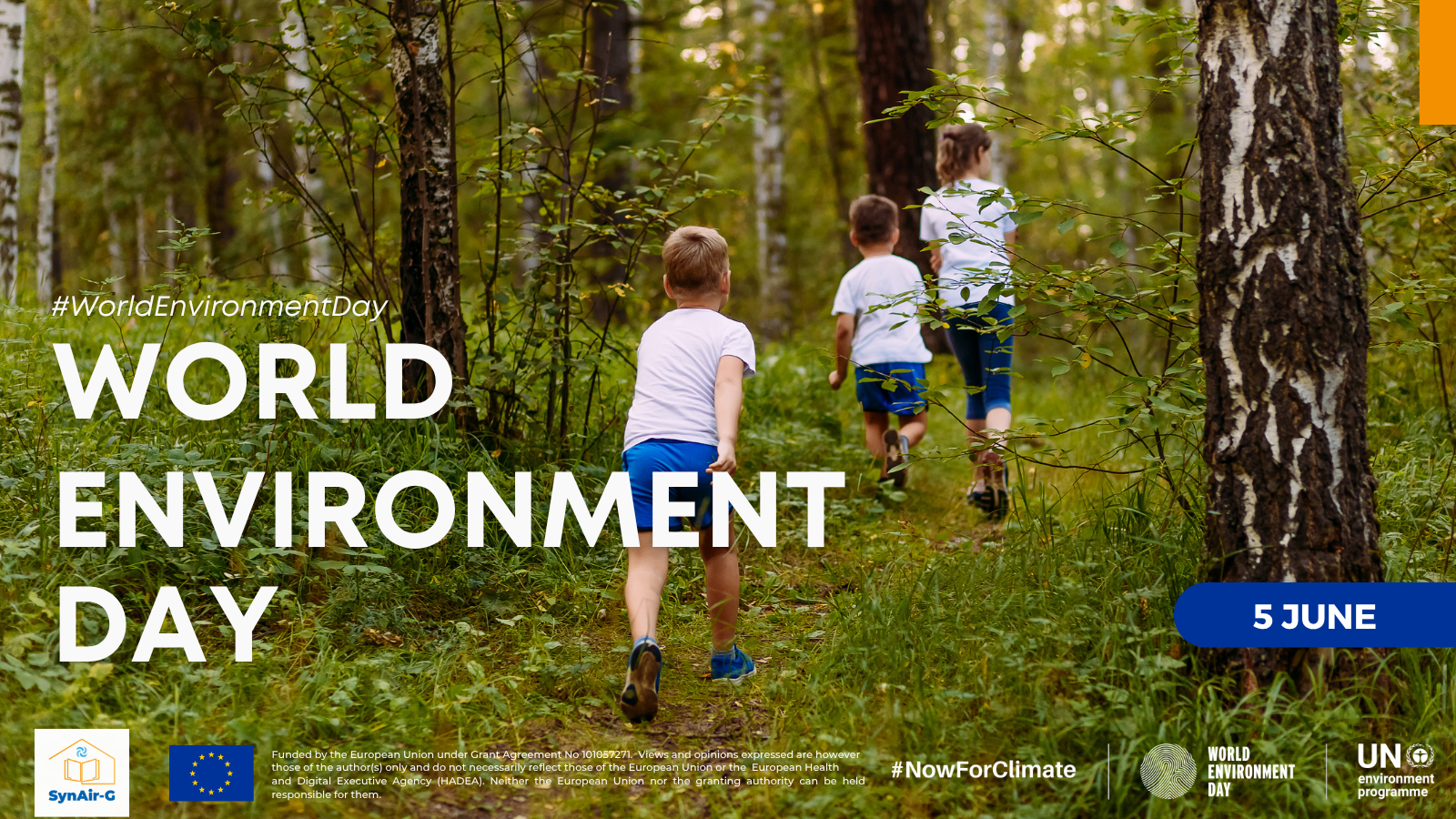
Each year, on June 5th, the United Nations Environment Programme (UNEP) leads World Environment Day (WED), a global initiative dedicated to raising awareness on the world’s most pressing environmental challenges. On this day, millions of people from governments, businesses, civil society organisations, schools, and communities come together to advocate for urgent environmental action.
This year’s UNEP Campaign focuses on Climate change. Under the slogan “The signals are clear. What comes next is up to us. #NowForClimate”, the campaign highlights the climate solutions that are already being implemented around the world and calls for continued action to address a changing climate and build a more sustainable future.
The SynAir-G project proudly supports this year’s World Environment Day campaign. Climate change has significant implications for both indoor air quality and respiratory health, particularly among vulnerable populations such as children and people living with asthma and allergies.
Climate Change and Indoor Air Quality: An Overlooked Connection
Outdoor air pollution remains one of the major contributors to indoor air pollution. As climate change alters environmental conditions, outdoor concentrations of pollutants may increase, including ozone, fine particulate matter, and biological contaminants such as viruses, bacteria, and fungi. Climate-related events such as wildfires, droughts, and dust storms can further deteriorate air quality, with pollutants infiltrating indoor spaces where people spend most of their time.
Climate change affects not only outdoor environments but also the quality of the air we breathe indoors. Rising temperatures and increasing humidity do not only have direct impacts on human health; they also increase emissions of indoor pollutants from sources such as building materials, furnishings, paints, and cleaning products. Warmer and more humid conditions can also promote the growth of mould and other biological contaminants indoors.
In addition, many of the measures and behavioural changes adopted to mitigate or adapt to climate change can influence indoor air quality. Changes in building design, insulation, ventilation practices, and increased use of air conditioning may alter indoor pollutant concentrations, sometimes with unintended consequences on the air quality.
The Impact on Children’s Health
As people spend an increasing proportion of their lives indoors, the health implications of indoor air pollution become even more significant. Children are particularly vulnerable, spending much of their day in classrooms and other indoor learning environments.
Exposure to indoor air pollution during childhood has been associated with impaired lung growth and function, increased risk of lower respiratory tract infections, the development and worsening of asthma and allergies, and respiratory complications later in life.
Climate change further amplifies these risks. Longer and more intense pollen seasons, higher concentrations of fungal allergens, increased mould growth, and changing distributions of allergens all contribute to greater allergen exposure. These factors can increase the risk of developing allergy and allergic asthma and exacerbate symptoms in those already affected.
Addressing climate change is not only an environmental imperative but also a public health necessity, helping to safeguard indoor air quality and protect the respiratory health of children across Europe.
How SynAir-G Is Making a Difference
The SynAir-G project is helping to unravel the complex interactions between indoor air pollutants and their effects on human health, with a particular focus on children with asthma and allergies who spend much of their time indoors at school. Over the past four years, the project has achieved significant milestones in advancing our understanding of indoor air pollution, the factors that influence it such as climate change and its health impacts. As climate change continues to intensify, these advances are more important than ever.
Using innovative in vitro and in vivo models, advanced sensor technologies, and the “Save the World” gamified application, SynAir-G has generated valuable new insights into how indoor air pollutants interact and affect children’s respiratory health . Advancing research has for example deepened understanding of the biological mechanisms underlying airway responses to key environmental stressors, such as particulate matter (PM) and rhinovirus (RV), including their combined impact on vulnerable populations such as children with asthma.
The project is also developing sustainable and environmentally friendly interventions to improve indoor air quality. A major milestone is the SynAir-G Green Walls: smart indoor gardens that use natural plants as filtration systems to remove pollutants from the air and create healthier indoor environments.
Towards Healthier Indoor Spaces for Every Child
At its core, SynAir-G aims to safeguard and promote citizens’ health and well-being by preventing diseases, reducing inequalities, and promoting health. With the growing link between climate change, indoor air quality and respiratory health, SynAir-G is working #NowForClimate to strengthen knowledge on indoor air quality (IAQ), develop practical and sustainable interventions, and advocate for strong, inter-sectoral and integrated IAQ policies, in line with the One Health approach.
In February 2026, SynAir-G, together with its sister projects, published a second Joint Policy Brief on “When Children Breathe: the Impact of Indoor Air Quality on Children’s Health” under the IDEAL Cluster, underscoring the need for a European standard for indoor air quality, as well as increased awareness and education on its importance for health.
This year, following World Environment Day, SynAir-G is organising two major events in Brussels to raise awareness on the importance of healthier indoor environments:
- Roundtable Discussion at the European Parliament on “Indoor Air Quality and Children: The Needed Leap Forward”
- 3rd workshop on “Smart Synergies for Action – connecting data, patients and policy on indoor air quality”.
The events will bring together policymakers, European Commission representatives, academics, clinicians, and researchers, fostering exchange and dialogue towards healthier indoor environments.
The knowledge and scientific evidence, sensor technologies, and innovative solutions developed through SynAir-G can be applied today, in a world in motion and shaped by climate change, to create healthier learning spaces for children across Europe and contribute to a future in which every child can learn, grow, and thrive in a healthy indoor environment.
Stay connected! Follow Synair-G on Twitter and LinkedIn, and subscribe to the SynAir-G Newsletter to receive latest updates.
References
- IDEAL Cluster. (2026). Joint Policy Brief 2: Indoor Air Quality and Health in Europe. Available at: https://www.idealcluster.eu/wp-content/uploads/2026/02/IDEAL-Cluster-Joint-Policy-Brief-2.pdf
- Wang, Y., et al. (2024). Climate Change, Indoor Air Pollution and Human Health: Emerging Challenges and Future Directions. Environmental Research, 246, 118080. Available at: https://www.sciencedirect.com/science/article/pii/S0013935123026087
- Jovanović, M., et al. (2022). Impact of Climate Change on Indoor Air Quality and Human Health. International Journal of Environmental Research and Public Health, 19(23), 15616. Available at: https://www.mdpi.com/1660-4601/19/23/15616
- Kanchongkittiphon, W., et al. (2022). Climate Change and Indoor Air Quality. In: Encyclopedia of Environmental Health. Springer Nature. Available at: https://link.springer.com/rwe/10.1007/978-981-16-7680-2_74
- Bousquet, J., et al. (2020). The need for clean air: The way air pollution and climate change affect allergic rhinitis and asthma. Allergy, 76(3), 750–760. Available at: https://onlinelibrary.wiley.com/doi/full/10.1111/all.14177