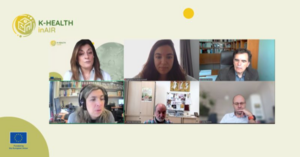
On 16 April 2026, SynAir-G participated in the webinar “Indoor Air Quality in Schools: From Pilot Experience to Policy Action”, organised by K-HEALTHinAIR.
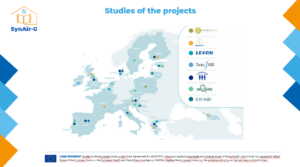
The event brought together researchers and experts from across Europe to examine how indoor air quality (IAQ) affects health, wellbeing, and learning environments in schools. The webinar showcased preliminary clinical findings from pilot studies conducted in Austria, Poland, and Greece as part of the K-HEALTHinAIR and SynAir-G projects, offering a comprehensive overview of indoor air quality challenges across different European contexts.
Monitoring Air Quality in Classrooms
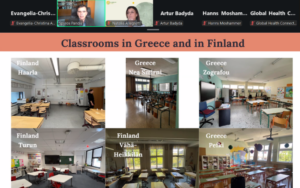
Professor Spyros Pandis (University of Patras, Department of Chemical Engineering) presented the methodologies used to monitor pollutants both inside and outside classrooms. Using ENSENSIA low-cost sensors alongside the Mobilab, researchers were able to capture detailed air quality data across different school environments.
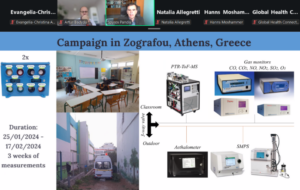
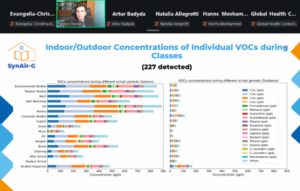
His analysis highlighted variations in volatile organic compound (VOC) concentrations between classrooms, with subjects such as Arts and Mathematics showing the highest levels, an insight that underlines how classroom activities can influence air quality.
Health Impact on Children
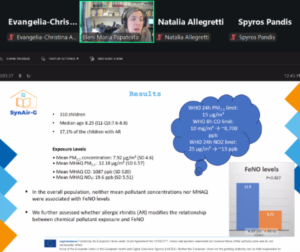
Eleni Maria Papatesta, Pediatrician and Research Fellow at the Allergology and Clinical Immunology Unit of the University of Athens, presented findings on the relationship between indoor air pollution and FeNO levels in children.
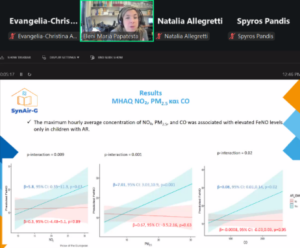
Her research demonstrated that exposure to elevated levels of PM2.5, NO₂, and CO is associated with increased FeNO levels in children with allergic rhinitis. These findings indicate a higher susceptibility to airway inflammation, reinforcing the need for targeted interventions to improve air quality in school environments.
Policy Insights from the IDEAL Cluster
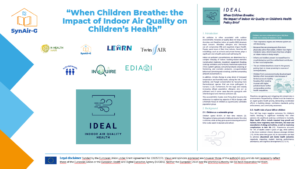
Evangelia-Christina Andreadi, Project Manager at the European Federation of Allergy and Airways Diseases Patients’ Associations (EFA), presented the second IDEAL Cluster Policy Brief titled “When Children Breathe: The Impact of Indoor Air Quality on Children’s Health.”
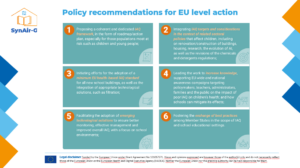
Drawing on data from more than 8,000 participants—primarily children aged 3 months to 18 years—she highlighted key policy gaps and challenges:
- There is no unified European standard covering all aspects of indoor air quality, from monitoring practices to health impact thresholds.
- Awareness of indoor air quality remains limited, with many people overlooking simple but effective measures such as regular ventilation.
Evidence from Austrian and Polish Pilot Studies
Findings from national pilot studies further illustrated the real-world implications of indoor air quality in schools. Hanns Moshammer, Senior Researcher at the Department for Environmental Health at the Medical University of Vienna, presented results from the Austrian pilot, highlighting key observations on classroom air quality.
Artur Badyda, Professor at the Warsaw University of Technology, shared findings from the Polish pilot study, providing additional evidence on students’ exposure to air pollutants in school environments. Together, these contributions reinforced the need for coordinated, evidence-based policies across Europe.
More information
SynAir-G extends its thanks to the K-HEALTHinAIR project for organising this important event and for connecting experts and sharing findings from real classroom environments in Europe.
You can find the agenda and the speakers list of the webinar here: Indoor Air Quality in Schools: From Pilot Experience to Policy Action – KHealthInAir
Watch the recording here: Indoor Air Quality in Schools: From Pilot Experience to Policy Action
Stay connected! Follow SynAir-G on Twitter and LinkedIn, and subscribe to the SynAir-G Newsletter to receive latest updates.