
We are excited to announce a significant milestone in our project’s technical development. To truly understand the complex relationship between indoor air pollutants in our environment and our health, we need high-quality data. Over the last period, we have successfully built the first robust version of our “digital AI engine” required to process this information.
Building a Strong Foundation: Data Collection & Quality
As illustrated in the workflow below, we have implemented a fully automated system to gather data from various sources (databases) and centralize it into a single Data Warehouse, from where we can retrieve the data properly. The process, known technically as ETL (Extract, Transform, Load), ensures that our data is consistent and ready for analysis.
Simultaneously, we launched a Data Availability Check mechanism. This can be seen as a sort of quality control; it automatically scans our datasets by time, location, and specific components to ensure nothing is missing. It even generates visual plots, allowing our researchers to instantly see “the big picture” of our data composition and spot any gaps.
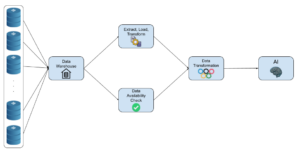
Figure 1: Illustrated workflow of data
From Data to Insights: The AI Pipeline.
With this solid foundation in place, we have activated our 1st automated AI Pipeline. This system takes the processed data (including ESSENSIA data) and trains advanced algorithms to learn. Specifically, the AI is now actively analyzing how air pollutants and environmental conditions impact human health, using metrics like vital signs and questionnaire responses.
SynAir-G at the ONE-Bridge in Health Conference
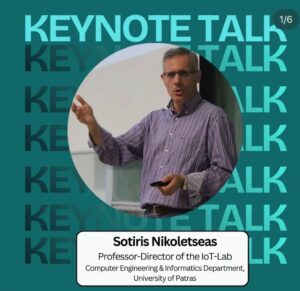
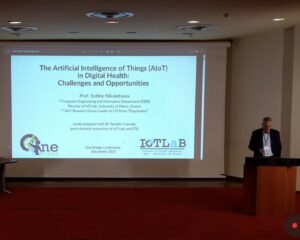
From 8-11 December 2025, the ONE-Bridge projects’ European One Health Conference took place in Patras, where Prof. Sotiris Nikoletseas from University of Patras delivered a Keynote presentation titled “The Artificial Intelligence of Things (AIoT) in Digital Health: Challenges and Opportunities”. His talk included preliminary findings from SynAir-G’s work on AI and data analysis, including on the development of the first version of the project’s “digital AI engine.”
Next steps
Our partners are meeting regularly to dive deeper into these findings. We are also currently designing a process to make this valuable dataset available to the public, ensuring that our research can benefit the wider scientific community.
Stay connected! Follow Synair-G on Twitter and LinkedIn, and subscribe to the SynAir-G Newsletter to receive latest updates.